~The Next Revolution In Art Will Be The Same, Old Revolution~
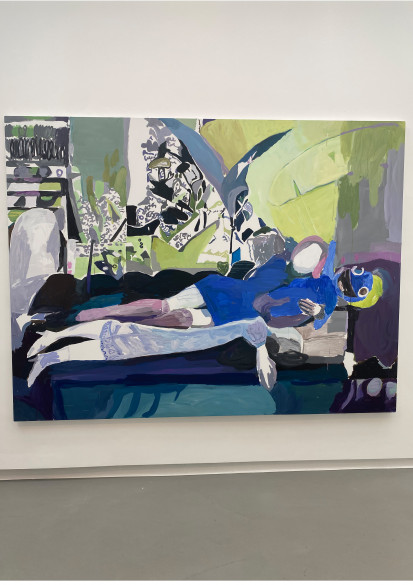
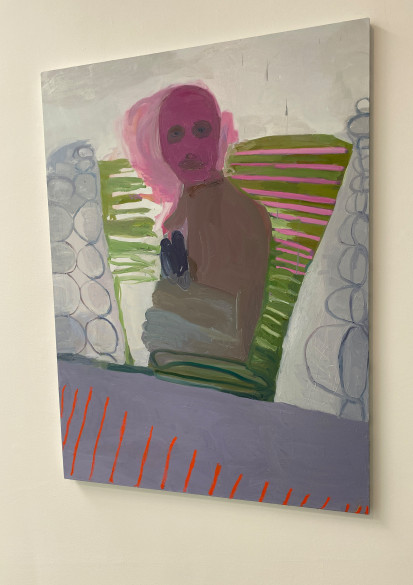
Because the artist is working within the tradition of the nude, which is an already an abstraction of the naked, I don’t know what the artist is trying to convey by abstracting the nude, further, by covering the faces of her subjects. The mask always tells more than the face. The main issue I take is how she’s depicted the faces: most faces in this show are painted masks. It’s a trend I’ve noticed recently; painting still doesn’t know what to do about Warhol’s faces. When Warhol used filmic reproduction techniques to layer the fascial, he was creating a sensitive disturbing neutrality, too sensitive for a desensitised milieu to properly learn from – the face as the mask, has yet to be accepted as a form that artists wants to take. The first painting you see shows the artist swinging to the opposite ends of the axis, away from the pendulums middle point that Warhol set in his neutrality. The egg shaped face of the artist-mannequin, but with the well rendered body, is one end of the axis (Foregoing the rendering of features is something Malevich did, but he rendered the whole body as mannequins and in doing subverted the need to render the sartorial, which showed the nude could withstand Modernism, improving the nude as a form). The opposite end of the axis is the artist rendering male pallet-thumbing masters with balloon heads, or, rendering balaclava clad militia wielding kalashnikovs. The decision to disconnect the head and the body, by obscuring, or, by playing up the face, comes off as a bad joke. They are gestures that shy away from art history. Whatever comment the artist is trying to make about the gaze and violence is lost in her bravado.
 THE CHAIR