
~Ian Macartney’s Ekphrasis inside the Many Walled Cities of Copenhagen~
Originally presented at the Ek Symposium, Glasgow Project Room, September 13th 2025~
Aske Thiberg is moving, but he’s going nowhere. His 2024 debut solo show (at Copenhagen’s Overgaden Institut for Samtidskunst, right by the Christianshavn metro stop) is a trilogy of performances. The first is by him; the latter two are performed by others. ‘Each choreography is synched to the same “theme song”’, Thiberg writes on his website, ‘a short and minimalistic recurring melody, filling the spaces void of almost anything but the performers’ bodies.’ Said theme song is plucked, faux-sincere, a VST emulating guitar; it has the anthemic quality you’d expect of a PBS documentary. As a (anti)climax, it goes up some semitones at the end, becomes piercing. Like, it should have more; more should be coming. More doesn’t arrive.
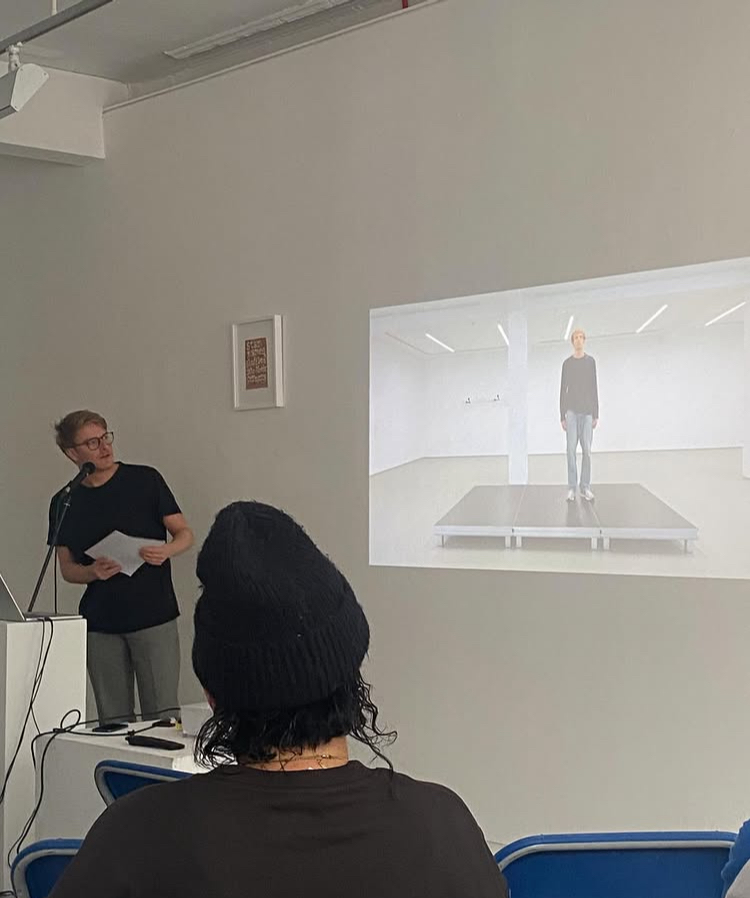
I caught the opening night of Shutting Out The Sun; I got to watch the artist in-person. How to describe his actions? There was the slapping of thighs, turns on the spot. One specific action where he dig-sways. Shimmies. Hits an arm to raise it up. Bends knees, shuffles backwards… repetition, additions, modulations. Neither clownery nor traditional dance. I was reminded of early peppy Disney, silent-era. Limp wrist as he spins his arm up, then down, elbow out. Gesture after gesture in a white-cube vacuum. Sometimes it corresponds to the beeps of the theme song, but sometimes not; Thiberg works towards a mysterious inner rhythm we don’t have access to. He is sweating by the end. It’s dynamic choreography, stop-starting, a quiet form of exertion. It’s as precise as automation, but still human action. Thiberg’s wide eyes imply he’s been set on autopilot, flesh in a structure.
He wears a wireless headset, reminiscent of Zumba coaches, televangelists and Britney Spears. This means, even before he speaks, you can hear his panting and breaths. His exertion is always audible. At exactly 10 minutes into the performance, he speaks, arms outstretched in both T-pose and crucifixion.
Eventually, he speaks. His vignettes sit on the edge of menace, without going there. They’re strange, intense, distant; peculiar, pop-cultural from the gutter; uncanny, domestic. Liminal. Kind of gross. One of his texts takes place in a grandpa’s living room, the last inside a plane. Two feature children, operating independent from their adults. Obfuscation comes up twice – the grandpa can’t see an inflatable guitar balloon when the sun sets, and a young girl can’t see her palm, when the aeroplane lights are turned off.
Of course I didn’t remember all of that in one go. To write this essay, I had to recreate the moment, control the duration via the reproduction on Thiberg’s website. Which is filmed in the empty Overgaden, without audience, so really a film in its own right, the splitting of performance into two: what once was, the trace, and then the documentation, going forward, without moving past the medium. Erika Balsom, writing on James Benning’s 2004 film TEN SKIES, comments on the kind of dependency that art writing sometimes has to digital reminders of the work:
All along, I have been studying not the film itself, but its ersatz double. The window playing TEN SKIES sits among others on my desktop. I can move it around, make it full-screen, or reduce it to the size of a Post-it note; I can skip to wherever I like, pause, play it at accelerated speed forwards or backwards. It goes without saying that my repeated viewing of this poor copy constitutes an experience altogether different from seeing the film as intended.
Digitality is, apparently, the centre of Shutting Out the Sun. ‘Thiberg portrays our contemporary bodies as ever-more robotic and cyborg-like’, the gallery website reads, ‘blurring reality and virtual, displaying how our bodies operate partially in the digital world, dependent on tech or body-borne computers’. This tends to a kind of ‘melancholy, whether nightly doom scrolling or the lonely gamer who is Shutting Out the Sun, as the title says’. For me, however, stumbling into the performance with no expectations, I feel the ramifications are wider. Alienation certainly glows in a digital context, but there’s something of the metropolitan context Shutting Out the Sun occurred in that can be considered. Maybe that’s part of my ekphrasis, here – I get to say what the artist shouldn’t. I guess I’m walking away from the action, so to speak, of the artwork itself. It’s hard to not be distant with it; the details don’t match what gets said, what has to be said, if this is going to go anywhere.
When I was in the Danish capital, I visited Christiana Freetown. This is the ‘ersatz double’ of Copenhagen, perhaps – and just a ten minute walk from the Overgaden. Known internationally as an anarchist/hippie community, C.M. Kökerer describes the area as ‘one of the most visited tourist attractions in Denmark […] a hybrid combination of resistance, autonomy, and neoliberalism’. It came to be when, ‘in early September 1971’, as Alexander Vasudevan writes, ‘local residents based in Christianshavn tore down part of the fence surrounding the recently abandoned Bådsmandstrstræde Barracks, a former military base in Christianshavn’s seventeenth-century defence ramparts. They set up a small playground for their children’. A group of activists then ‘broke into the base and began to explore the over eighty-five acres of barracks, workshops and halls’. Word reached out; the public were invited to explore the ‘‘forbidden city’ (‘forbudte by’) […] the area was soon swamped by young people who quickly established themselves in the barracks’.
I’m fascinated by this ludic origin – the first thing to be set up, once the military context collapsed, was a playground. Thiberg engages in a strange kind of play, too: not just ‘play’ as in theatrical performance, but also in the multimedia elements of his work. Earlier art, such as Now I see things for the way it is (2019), are 3D animations, a genre Thiberg is profoundly adept at creating. The vignettes in Shutting Out the Sun also have a playfulness to them, the sense of a daydream unspooling (like the thousands of threads that get stuck in a little girl’s toenail, in the aeroplane).
The other ‘playground’ of Copenhagen, what Tim Edensor and Mikkel Bille call a ‘ersatz rural idyll’ is Tivoli Gardens. As one of the oldest theme parks in the world, dating back to the 1840s, its playfulness is explicit – while Freetown Christiana became a spectacle in the sublimation of counterculture to culture, Tivoli has always been clear in its intentions. ‘A remarkably multiple landscape with diverse attractions, zones, pathways and designs’, the park is ‘replete with fairground stalls and white-knuckle rides, including the lofty Golden Tower, the vertiginous Star Flyer, the imposing Fata Morgana and the old roller coaster from 1914’. For 19th-century residents of Copenhagen, this Tivoli was ‘a location at which citizens could adjust to new forms of urban and industrial life; test out the possibilities offered by new technologies, and become habituated to the city as a ‘world of strangers’’.
A playground for urban alienation, then. When Thiberg gets on stage, he could be a backup dancer for some showcase at this funfair, though his choreography implies a malfunction in the social order, the expectation of things. Urban culture, resituated in the context of a gallery performance – performance of performance, the kind associated with people who’d be involved in, say, the formation of Christiana Freetown. Not some carnival float, but the white cube, and a black stage.
Martin Zerlang writes that, when established, Tivoli was ‘a model city, a city-within the city, a walled city just as the old Copenhagen, but at the same time a harbinger of the new Copenhagen striving after openness and wider horizons’:
Since the Middle Ages Copenhagen had been surrounded by walls and moats, and when the Absolutist regime established itself in the seventeenth-century Copenhagen became a visible expression of the high level of military art with its system of ramparts, which made the city itself into a perfect circle, while the polygons of the bastions pushed out into the Sound and the country. The whole layout has been compared to the arms of a loving mother embracing her little child, but in the 1840s this embrace was experienced as a stranglehold.
The second of Thiberg’s vignettes describes such a tight grip: a father refuses to let go of his son, while hugging him on return from a business trip. If Freetown and Tivoli responded to overt capitalism, then exploring the vicissitudes of capitalist logic sits at the heart of Shutting Out the Sun.
’Capitalist logic’ being ‘the logic of power’. Both of Copenhagen’s ‘playgrounds’, Freetown Christiana and Tivoli Gardens, are pleasure spaces bordered by the military. On the day I arrived in Denmark, I met up with that aforementioned friend Aske, that ‘authentic double’ to Akse Thiberg, at somewhere called Kastellet. From above, it looks like Super Mario’s Mushroom Kingdom, except fascist: a historical barracks, enclosed within a precisely-hewn star-shaped moat. Google Translate tells me it means ‘The Citadel’, though I think of stellation as well, star-making, or Star Flyer, as per the Tivoli ride.
I was staying with a ceramist friend not far from here – her partner, a former Marine, had a new consultancy job with NATO, which meant they both had rent-free access to a luxurious flat (I met him in the latter half of my time in Copenhagen; he had been in five European capitals in five days, the last being Warsaw). In this sense, my very (leisure-)stay in Denmark was aided by the inadvertent consequences of European military power.
Days later, when I wandered through Tivoli Gardens, I went on no rides. It was a hasty wander; I’m impatient, and too anxious for rollercoasters. I had a similar experience in Christiana Freetown – the area didn’t take much time to traverse, as a loop, bright August sun bearing down, un-shuttered. It’s not that I didn’t enjoy these spaces, just that I embraced the surface as I, a foreigner, only could. I was practising a limp kind of flâneuring, moving without going anywhere beyond the consciousness of ‘tourist’.
When outside Christiana Freetown, having finished my wander, a man came up to me. He said something curt; I didn’t hear him, nor understand the language. Then, he repeated: ‘hash?’ I laughed, self-conscious, unsure if I was to be supplier or the customer. I said no. Without a further word he left, and I headed in the opposite direction, glancing at my phone, on the hunt for a €6 coffee.
References
https://askethiberg.com/Shutting-Out-the-Sun [accessed 2 September 2025]
Erika Balsom, TEN SKIES (Australia: Fireflies Press, 2021), p. 134
https://overgaden.org/en/exhibitions/shutting-out-the-sun [accessed 27 August 2025]
Kökerer, Can Mert, ‘Art and Politics in Freetown Christiania: a Benjaminian and Brechtian Utopia?’, International Journal of Politics, Culture, and Society, 34 (September 2021), pp. 359–377, doi:10.1007/s10767-019-09341-8
Vasudevan, Alexander, The autonomous city: a history of urban squatting (London: Verso, 2017), p. 72
Edensor, Tim and Bille, Mikkel, ‘‘Always like never before’: learning from the lumitopia of Tivoli Gardens’, Social & Cultural Geography, 20:7 (2019), pp. 938–959, doi:10.1080/14649365.2017.1404120
Zerlang, Martin, ‘Orientalism and modernity: Tivoli in Copenhagen’, Nineteenth-Century Contexts, 20:1 (1997), pp. 81–110, doi:10.1080/08905499708583441
 THE CHAIR