~A review of Matthew Darbyshire’s 2018 “11 Rue Simon Crubellier”~
I used to rent a room in a third floor apartment which used to be a part of the old Olympic Village in Amsterdam. Though the complex was built for the 1928 Olympic Games, it was always intended to become residential housing after they concluded. The buildings were designed by the architect Jan Wils—who won the Gold Medal for his architecture, an Olympic category until 1948. Today, the area is a prime example of the tension between Amsterdam School brickwork and an early iteration of De Stijl.
I had a multi-angled bay window. From this window there was a perfect view of the town square below. I could use the protruding curve and diagonally positioned side panels to get a broader perspective. Occasionally, I spent hours observing the outside from that spot. People queuing up for fried fish; cyclists cutting corners; dogs pissing; residents taking out their trash; streetlights turning on at 20:00; employees kicking a football on their lunch break; outdoor workouts for pregnant women; pigeons eating crumbs; and so on and so forth.
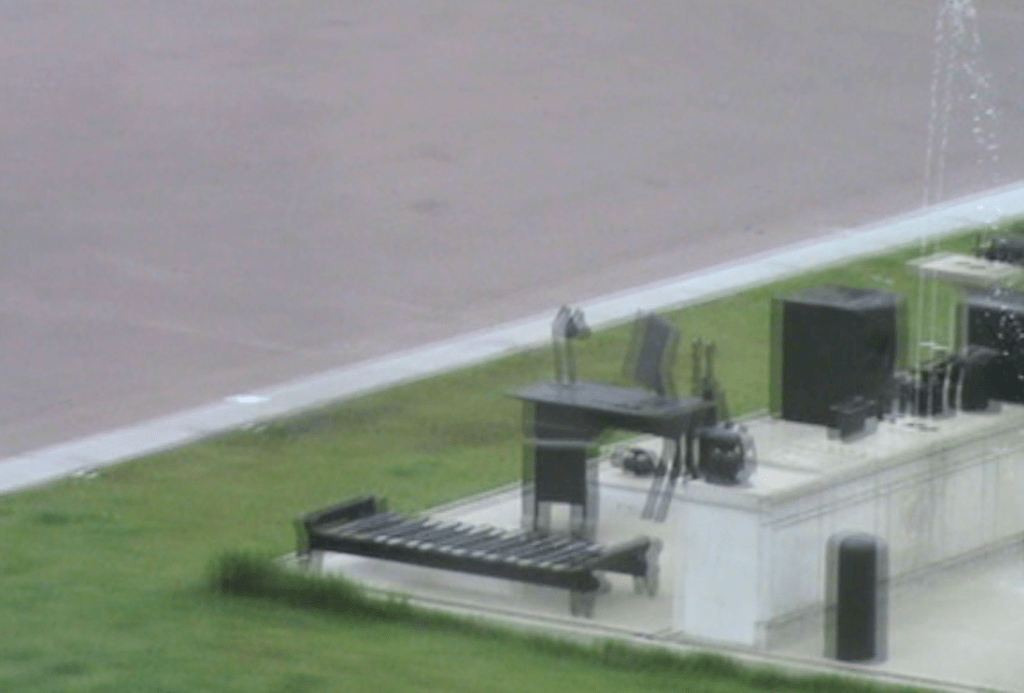
At some point during my time there, I watched, from my prime position, the creation of a public artwork. An interactive sculpture was constructed on the north side of the town square, interrupting my routine beeline to the supermarket, and directly visible from the right panel of my bay window. The artwork was named 11 Rue Simon Crubellier after the fictitious apartment block in George Perec’s novel La Vie mode d’emploi (Life a User’s Manual) from 1978.
The artist in question had won a funding proposal and could conceive his meta-conceptual idea of re-creating Perec’s fictitious apartment in real life. Residents from a 5-kilometre radius were invited to participate in the decisions behind what would furnish their “dream apartment”. The most voted for furniture designs would be bronze cast at a foundry in Tiel. I did not participate.
The bronze objects, which looked almost identical to their originals—only slightly bulkier—appeared one by one, transported via a big truck and placed on the cement stage that marked the perimeters of the “apartment”. After all the household “essentials” were placed, the sculpture was finished. No roof, no walls. Designer classics such as the Fritz Hansen egg chair (circa €13,000) were amongst the 30 objects furnishing the apartment.
What ensued at the town square’s new and shiny addition, 11 Rue Simon Crubellier, was watched daily by me from my spot at the bay window. In this way, I was presented with a real-life metaphor for the public artwork’s problematic blind spot that I had been trying to put my finger on.
One sunny day, a homeless man walked past the town square. He had a rolly suitcase and multiple plastic bags stuffed with belongings. He did a double take. Backtracked. And then decided to “move-in”. I watched as he gradually made himself more and more comfortable in the bronze-cast bed, then the bronze-cast sofa—which he seemed to prefer as a sleeping spot. He unpacked his suitcase into the bronze-cast shelving unit, hiding his more prized possessions under the bronze-cast coffee table (Noguchi, circa €2,630). I still don’t know whether nobody told him to leave because of the sporadically open-minded social contract in Amsterdam or because it felt far too ironic to kick a homeless person out of a public sculpture that resembled a home.
As the days turned to weeks, I—naive art student that I was—plucked up the courage to interview the man who had moved in. To this day I have our full conversation on a hard drive. “It’s my style,” he told me, gesticulating towards the bronze-cast furniture. “All I need is walls and a roof.” I had dreams of editing something that captured the audacity of Amsterdam’s multimillion euro budget going towards public artworks of this demeanour when it could have gone towards the homelessness crisis. Not to undermine art, but to underline homelessness. In the end, I could not bring myself to use the footage. It felt wrong.
About a month into his stay, as if to push my metaphor to its brim, the public sculpture’s fake radiator started to squirt water. The artwork became a fountain. Needless to say, Anyo—that was his name—moved out.
 THE CHAIR